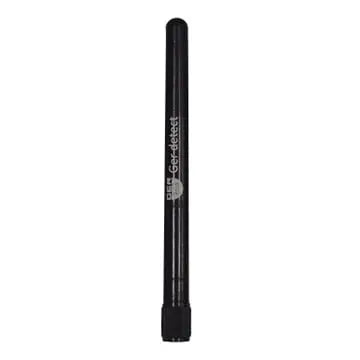
GER Detect Titan 400 Smart Metal Detector
Depth: 25 meters
Distance: 3000 square meters
GER Detect Titan 400 Smart Metal Detector device, with a completely new design, is the first of its kind in the world.
GER Detect Titan 400 Smart Metal Detector device can bypass all types of mineral rocks with automatic calibration technology, including sedimentary, metamorphic, and igneous rocks, which consist of two types:
Granite and Basalt, which are among the worst types of rocks that impede the work of many devices in the market, due to the change in the rocks as a result of their chemical interaction with the earth and their transformation into rock tissue, i.e., mineral components.
This device also has the advantage of automatically switching to search systems once the parts for each system are installed.
Three Search Systems in one Device.
- The Long-Range Search System.
- The Ionic Fields Search System.
- VLF Metal Detection System.
Long Range Search System:
This system is characterized by high accuracy in identifying and monitoring the target location and restricting it within a square meter distance.
- The device starts searching by showing light signals on the screen to show that the device is sending and receiving signals that direct you towards the target.
- When a signal is received, the device will activate three functions at once to confirm the presence of the target
- The turning of the signal recipient towards the target directly.The direction of the target appears on the smart screen.
- Making a beep sound when the signal recipient turns towards the target.
- Confirm the direction of the target using the four directions to ensure more accurate reach to the target.
- Trace the signal and when the signal recipient turns back, this means that you have gone past the target
- Narrow the search location by marking it as the center of the target to be confirmed.
- Then confirm the location of the target from the four directions (from south to north – from north to south – from west to east – from east to west).
Features of this system:
A system screen containing:- Target direction locating indicator.
- The front range of the device.
- Sensitivity level.
- The possibility of choosing the appropriate front range for the search area to be covered (from 100 meters to 500 – 1000 – 1500 – 2000 – 2500 – 3000) square meters.
- The ability to control the level of sensitivity.
- The depth in the long-range system reaches 25 meters underground.
Ionic Field Search System:
It is a system that specializes in detecting ionic fields that form around gold and buried treasures long time ago.
Search by moving the device from right to left, it should have an angle equivalent to 180 degrees and when a sound signal is heard and the cursor appears on the screen, this indicates that a target has been discovered.
Follow the beep by moving the device up and down. When you reach above the target, the device’s sound will accelerate to confirm the presence of the target directly under the device
The depth in the ionic system reaches 25 meters underground and the front range is 3000 meters.
VLF Search System:
An advanced automatic Very Low Frequency (VLF) system with high accuracy in identifying metals, up to a depth of 3 meters underground.
A fully automatic operating system that is not affected by soil types: wet or rich in mineral salts or mineral rocks.
This system also has:
Discrimination and search for precious metals system, is characterized by rejecting signals resulting from iron or non-precious targets, allowing you to search for precious metals only (such as gold, silver, bronze, and coins).
The general search system, that is, the search for precious and non-precious metals: This system searches for all types of metals with high accuracy, in addition to distinguishing between precious and non-precious metals.
The VLF system screen contains several indicators:
- An indicator of the level of non-precious metals (ferrous).
- An indicator of the level of precious metals (non-ferrous).
- A positive (+) button and a negative (-) button to control the sensitivity level. of the search coil.
- The (x) button to “ignore Iron”.
Frequently Asked Questions (FAQ)
What is the detection depth of your metal detectors?
Our metal detectors vary in detection depth depending on the model and the type of metal being detected. Generally, our detectors can identify targets at depths ranging from a few inches to several feet. For specific models, please refer to the product specifications on our website.
Can I test my metal detector with freshly buried metals?
Freshly buried metals cannot be detected immediately. For a metal detector to sense the buried metal, it needs to disrupt the magnetic field, which requires the metal to remain underground for a certain amount of time.
What is the detection distance of your professional metal detectors?
Professional metal detectors locate metals buried for many years by detecting subtle environmental changes caused by these metals. They utilize bio-energy interaction, ionization technology, electromagnetic field detection, advanced microprocessor analysis, long-term soil disturbance detection, and sensor fusion. The longer the burial time, the easier it is to detect these metals due to more pronounced ion fields and electromagnetic signatures.
What factors affect detection capability?
Several factors can influence detection capability, including:
● Soil Conditions: Mineralization levels and moisture can impact performance.
● Target Size: Larger targets are typically detected at greater depths than smaller ones.
● Detector Settings: Adjusting sensitivity and discrimination can help optimize detection.
What are some practical testing methods for professional metal detectors?
● Field Testing in Historic Sites: Test in areas with known buried metal objects, like historical battlefields or archaeological sites (with permission).
● Using Known Buried Objects: Test in places where long-buried metals are documented, such as old farm fields or construction sites.
● Avoid Air Testing: Do not test with unburied or freshly buried metals. These detectors work by detecting ionization fields around long-buried metals, unlike hobby detectors.
● Avoid Testing Inside Structures: Testing indoors can lead to interference from numerous cables, electrical systems, and other factors that can affect the performance of professional detectors.
How do I maintain my metal detector?
To keep your metal detector in top shape:
● Clean After Use: Remove dirt and moisture from the detector, especially the coil.
● Store Properly: Keep it in a cool, dry place and avoid extreme temperatures.
● Check Batteries: Regularly check and replace batteries to ensure optimal performance.
Can I use my metal detector into the water?
Some of our metal detectors are designed for water use, while others are not. Always check the product specifications to see if your model is waterproof or submersible before using it in water.
What should I do if my metal detector isn't working properly?
If your metal detector isn't working, please follow these steps:
● Send Us a Video: First, send us a video demonstrating how you are using the detector. In 95% of cases, the issue is due to user error.
● Technical Review: Our technical team and the manufacturer will review the video to determine the cause of the issue.
● Next Steps: Based on their assessment, we will provide a solution, which may include fixing the device, replacing it, or confirming that it’s a user error.